A check engine light coming on a Friday night, a cracked brake disc spotted during the technical inspection, a torn mirror in a parking lot: we rarely order auto parts for pleasure. The pressure of time pushes us to click quickly, and that’s when compatibility errors or bad deals multiply. Choosing the right auto parts online relies on a few concrete reflexes, provided we apply them before pulling out the credit card.
OEM reference and chassis number: the two checks that prevent returns
On a spare parts website, the photo is never enough. Two oil filters may look identical but differ in thread pitch or gasket diameter. The only reliable data is the OEM reference engraved on the original part.
You can find it either on the part itself (a molded marking, a label) or in the manufacturer’s technical documentation. When it’s not at hand, the vehicle identification number (VIN, visible on the registration document or at the bottom of the windshield) allows online catalogs to filter compatible references accurately.
By cross-referencing make, model, year, engine type, and VIN, you eliminate most errors. On carburauto.fr, this data cross-referencing is integrated directly into the search engine, reducing the risk of ordering an unsuitable part.
One last often-overlooked point: some parts change reference during the production of the same model. A Peugeot 308 produced at the beginning and end of a series may have different engine mounts. Checking the exact date of first registration, not just the model year, avoids this trap.

Original part, aftermarket, or from the circular economy: decide based on actual use
The most common reflex is to sort by ascending price. You then come across aftermarket parts sold significantly cheaper than the equivalent from the manufacturer. The question is not whether they are “less good,” but whether they are suitable for your specific situation.
OEM part and aftermarket part: what changes concretely
An OEM (Original Equipment Manufacturer) part comes off the same production line as the one installed at the factory, but it is marketed under the supplier’s brand rather than the manufacturer’s. The quality level is identical; only the packaging changes. This is often the best value for money for mechanical components.
An aftermarket part is manufactured by a third party, according to specifications that may vary. For an air filter or a windshield wiper, the difference is rarely noticeable. For a shock absorber or a clutch kit, feedback varies on this point: some aftermarket suppliers offer comparable durability, others do not.
Parts from the circular economy: a legally regulated option
Since 2016, every automotive repair professional in France must offer parts from the circular economy (PRIEC) before resorting to new parts. Decree No. 2024-823 of October 1, 2024, strengthened this obligation by specifying the information and traceability requirements.
For online purchases, this means that a site linked to a garage or operating as a repair professional must be able to justify that it informed you about the PRIEC option. In practice, you can now find checked used parts and refurbished items (alternators, starters, turbochargers) with a legal compliance warranty of 12 months for used parts and 24 months for refurbished ones.
Legal warranty and return policy: what the price doesn’t tell you
An attractive price loses all interest if the part arrives defective and the return costs more than the savings made. Before confirming an order, check three elements that weigh as much as the unit price:
- Legal compliance warranty: 24 months on new and refurbished parts, 12 months on used parts. If a site displays a shorter duration, it does not comply with French regulations.
- Return policy and withdrawal period: the 14-day withdrawal right applies to online purchases, but some custom or installed parts may be excluded. Reading the general terms and conditions before purchasing avoids unpleasant surprises.
- Return shipping costs: some sites offer free returns, while others charge for return shipping. For a heavy part (brake disc, bumper), these costs can be significant.
Counterfeit auto parts online: spotting warning signs
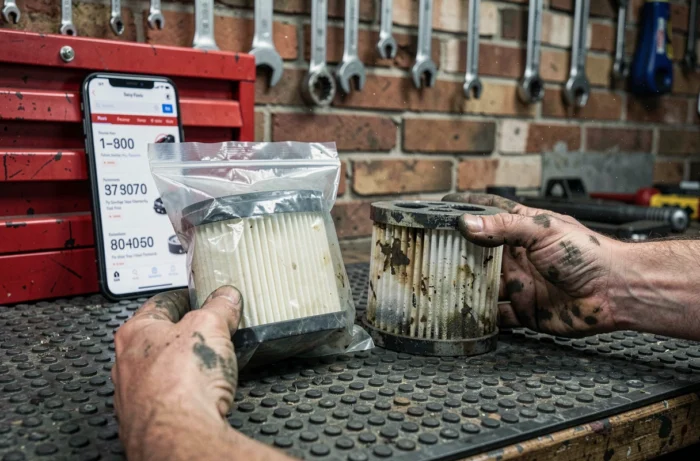
The counterfeit market in Europe represents several tens of billions of euros annually across all sectors, and auto parts are among the most targeted products. A counterfeit brake pad may contain materials that do not withstand heat, with direct consequences on braking distance.
Several signals should alert you when purchasing online:
- An abnormally low price compared to the average price observed on several sites for the same OEM reference.
- The absence of standardized marking on the part (manufacturer’s logo, batch number, ECE certification for lighting or braking elements).
- Poor quality packaging, without hologram or verification code, whereas the original manufacturer systematically uses them.
- A marketplace seller without a history of verified reviews or physical contact details in France.
Comparing prices on at least three specialized sites remains the simplest filter. If an offer is half the price of all the others, the risk of counterfeiting or very low-quality parts increases significantly.
Compatibility check after receipt: the reflex that is often missing
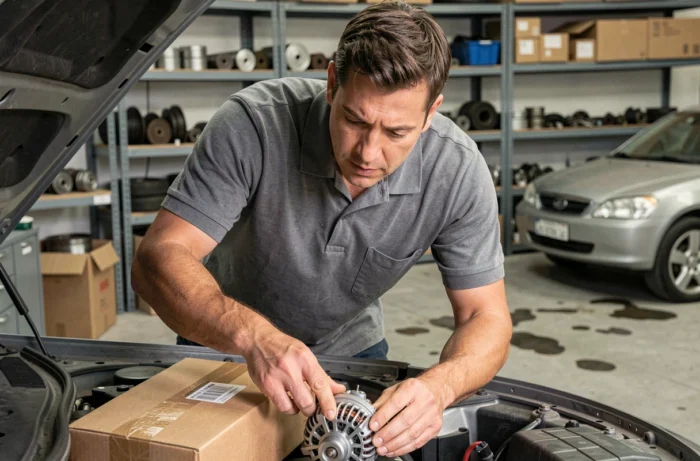
You open the package, visually compare it with the old part, and install it. This sequence skips a step that could avoid many problems: checking the reference on the received part and comparing it to the one ordered.
A discrepancy of a few characters may indicate a slightly different version (manufacturing revision, variant for another market). For braking or steering components, this check takes thirty seconds and can prevent unnecessary disassembly and reassembly, or even a safety issue.
For body parts (fender, hood, bumper), checking the mounting points and clip locations before any painting allows you to detect incompatibility without incurring additional costs.
The choice of an auto part online rarely hinges on the moment of clicking. It is made upstream, when noting the correct reference, and downstream, when opening the package with the technical documentation at hand. Between the two, price remains one criterion among others, never the only one.