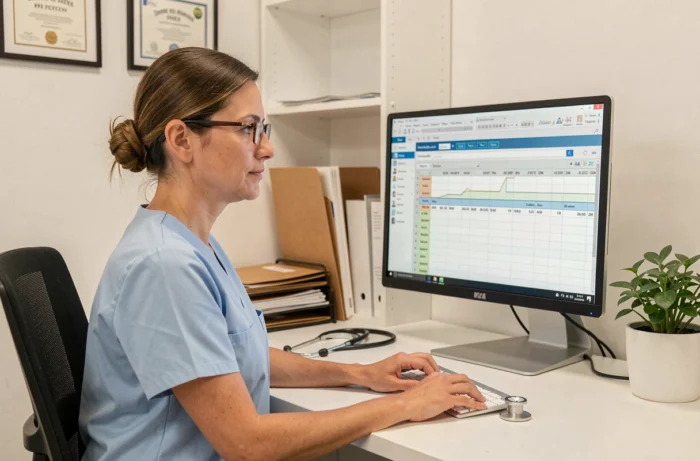
Independent nurses dedicate a significant portion of their working time to tasks that do not directly involve care: billing, teletransmission, route coordination, and maintaining patient records. Nursing software aims to reduce this administrative burden, but the context in which these tools operate has changed. Regulatory pressures, the requirements of the Ségur du numérique, and the increase in cyberattacks on the healthcare sector are reshaping the criteria for choosing a management solution for an IDEL practice.
Cybersecurity and nursing software: a blind spot for independent practices
Comparative articles on nursing management software mention data security as a generic asset. Recent events necessitate a more concrete interpretation. In 2024, Cegedim Santé was fined 800,000 euros by the CNIL for processing non-anonymized health data without authorization. This type of sanction no longer only concerns large hospital groups.
In August 2026, the Alaxione platform suffered a claimed hack potentially affecting several million patient records and medical appointments. Santé publique France confirmed that during the same period, a cyberattack compromised contact data on a document ordering platform for prevention materials.
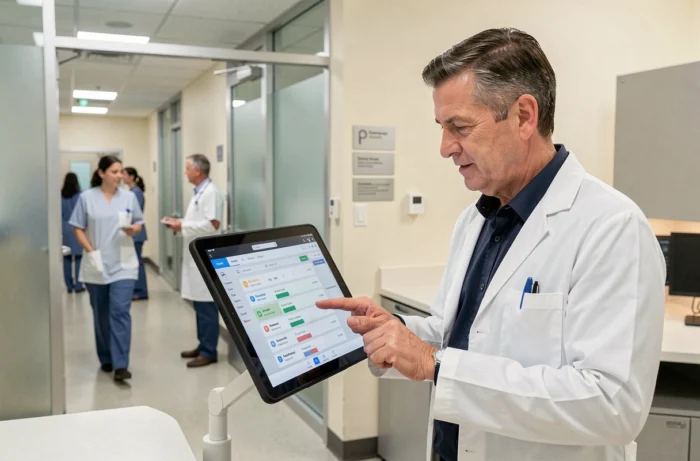
For an IDEL practice, these incidents raise a direct question: does the software used daily guarantee access logging, strong authentication, and verifiable CNIL compliance? Field feedback varies on this point. Some publishers display certifications, while others are content with vague mentions of encryption. An independent healthcare professional is responsible for protecting their patients’ data, even when delegating storage to a cloud provider. Among the referenced solutions, the nursing software provider from 123 Docteur offers a suite that integrates these security dimensions in an environment designed for independent healthcare professionals.
Ségur du numérique certification: what it changes for choosing an IDEL management software
The Ségur du numérique program requires health software publishers to comply with interoperability standards to be eligible for public funding. Wave 2 of the Ségur extends these requirements to software for paramedical professionals, including IDELs.
A Ségur-certified software must enable the exchange of health documents via standardized formats and the feeding of the Shared Medical Record (DMP). For a nursing practice, this means that choosing non-certified software closes access to equipment subsidies and complicates coordination with doctors, pharmacists, and other professionals in the care chain.
The technical standards used (HL7 FHIR, CI-SIS content module) are not trivial. They determine the software’s ability to transmit a nursing care report readable by the information system of a hospital or a multi-professional health center. Software that manages billing and teletransmission of Sesam Vitale without adhering to these interoperability standards remains a partial tool.
Technical criteria to check before committing
- The Ségur wave 2 certification of the software, which can be consulted on the official list published by the ANS (Agence du Numérique en Santé).
- Compatibility with the CPS card and Sesam Vitale reader for the teletransmission of electronic care sheets to the Assurance Maladie.
- Native management of the DMP and the ability to produce documents in an interoperable format (medical summary module, nursing report).
- The presence of a timestamped access log for patient records, a requirement reinforced by the CNIL since recent sanctions in the healthcare sector.
Route management and NGAP billing: where nursing software truly saves time
Route optimization is the most common sales argument from publishers. In practice, the gain heavily depends on the area of practice and the number of patients followed. An IDEL working in a restricted urban area does not benefit from a planning algorithm as much as a professional covering several rural municipalities.
The real productivity lever often lies elsewhere: in the automatic coding of acts according to the NGAP (General Nomenclature of Professional Acts). Coding errors are a frequent source of rejections by health insurance funds. Software that automatically associates the correct code with the act performed, taking into account surcharges (night, Sunday, travel), reduces administrative back-and-forth and accelerates collections.
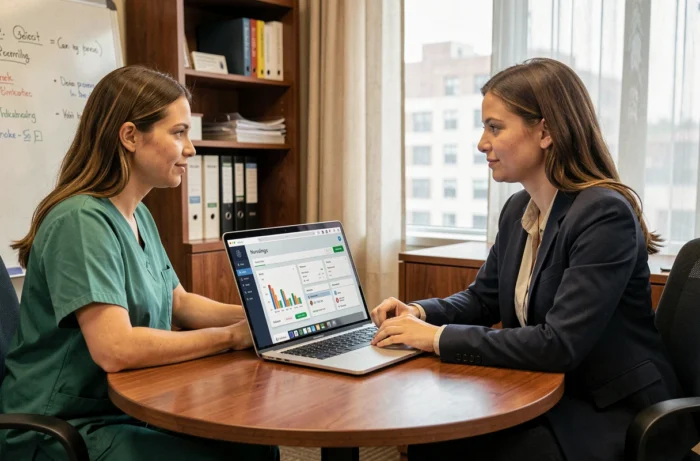
The teletransmission of electronic care sheets remains the functional foundation of any IDEL software. The available data does not allow for concluding that one publisher processes faster than another: reimbursement times also depend on the information system of the receiving fund. However, software that reports billing anomalies in real-time before sending avoids weeks of adjustments.
Collaborative practice: needs that solo software does not cover
A practice with two to five IDELs introduces constraints absent in individual practice. Patient sharing, management of replacements, calculation of retrocessions, and real-time shared scheduling require software designed for multi-users with distinct roles and permissions.
A principal must be able to supervise the practice’s activity without accessing the billed acts by a substitute on their own patient list. A collaborator should only see the patients assigned to them. Without this granularity, the practice falls back on parallel files and informal exchanges that negate the benefits of digitization.
Nursing software and CNIL compliance: responsibility of the independent professional
The CNIL has tightened its controls on the cybersecurity components of health software. For an IDEL, responsibility does not stop at choosing a compliant publisher. The independent professional is responsible for processing under the GDPR for their patients’ data.
This implies checking that the contract with the publisher includes a subcontracting clause compliant with Article 28 of the GDPR, that backups are hosted on HDS-certified servers (Health Data Host), and that security updates are applied without delay. Software that performs well on billing but is opaque on these points exposes the practice to real legal and financial risks, as illustrated by the sanctions imposed in the last two years in the sector.
The choice of management software for a nursing practice is no longer limited to comparing pricing grids or feature lists. Regulatory compliance, robustness against cyber threats, and Ségur interoperability have become as crucial as the ergonomics of the interface or the quality of technical support.