
On a a combined steam oven, the question arises with each first use: should the water reservoir be filled for every cooking session, or does the oven manage it on its own? The answer depends on the type of appliance, the dish being prepared, and the actual level of humidity needed in the chamber. Confusing an integrated steam oven with a traditional oven where a ramekin of water is placed is missing what makes the difference in the final result.
Residual humidity in the oven: what no one measures
When starting a steam cooking session after filling the reservoir, one expects a stable humidity level in the chamber. In practice, feedback varies on this point. Some combined steam ovens regulate continuous injection, while others send bursts of steam intermittently, with pauses of varying lengths depending on the set temperature.
The problem is that the actual humidity in the chamber is never displayed on most consumer models. You set a temperature, select a steam mode, but you don’t know if the air around the dish contains enough humidity to cook a fish fillet without drying it out, or too much to achieve a proper bread crust.
On professional models, a humidity probe controls water injection in real-time. On a domestic oven, this regulation is often simplified. The reservoir empties, the steam decreases, and you only realize it when opening the door.
If you’re looking to understand when and how to add water to a steam oven, the first step is to identify your appliance’s system: removable reservoir, direct water connection, or simple “steam burst” function on a traditional oven.
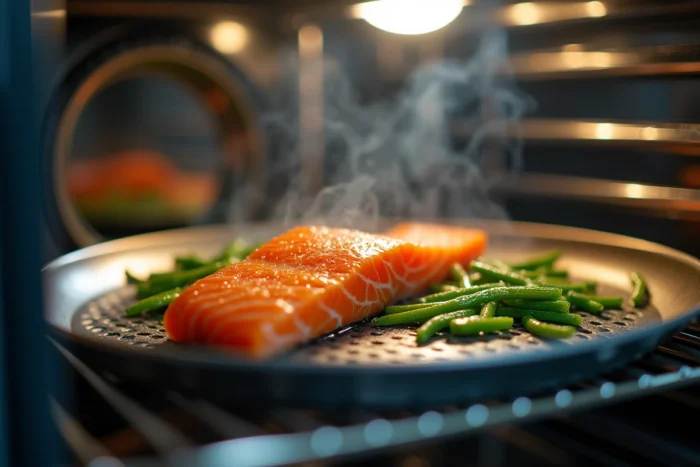
Integrated reservoir or ramekin of water: two steam cooking logics
A combined steam oven produces steam via a dedicated reservoir, sometimes directly connected to the water supply. The water is heated in a separate generator, and the steam is injected into the chamber in a controlled manner. This mechanism allows for continuous humidity throughout the cooking duration.
Placing a ramekin of water at the bottom of a traditional oven does not yield the same result. Evaporation is sporadic, concentrated at the start, and decreases as the water heats and the oven reaches its cruising temperature. This method remains useful for two specific cases:
- Bread and pastries, where a spike in humidity in the first few minutes promotes crust development and dough rising
- Long-cooking meats (roasts, shoulders), where a base of water in the dish limits surface drying without requiring a true steam mode
- Reheating already cooked dishes, to restore moisture without going through a full cooking process
Outside of these situations, simply adding water does not replace regulated steam injection. For vegetables, fish, or low-temperature cooking, only a true steam generator maintains the necessary conditions.
When not to add water to a combined steam oven
The reflex to systematically fill the reservoir can backfire on the result. Some cooking processes require dry air to function.
A roast chicken needs dry heat for the skin to become crispy. If the steam mode remains activated throughout the cooking, the skin will stay soft, regardless of the time spent in the oven. The same logic applies to gratins, pies, or vegetables that one wants to caramelize: humidity prevents the Maillard reaction, which gives color and grilled flavor to the surface.
On a combined steam oven, the mixed mode (convection heat + steam) allows you to play on both fronts. You start cooking with steam to keep the interior moist, then cut off water injection in the last few minutes to achieve crispiness. This sequencing is the true added value of a combined oven compared to a pure steam oven or a traditional oven with a ramekin.
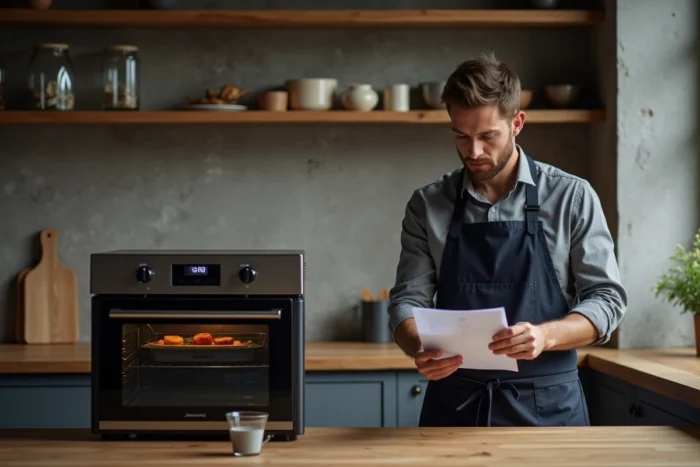
Maintenance of the reservoir and humidity removal after cooking
We rarely think about what happens after cooking, and this is an angle that most guides overlook. Stagnant water in the reservoir, combined with residual heat, creates a favorable environment for limescale deposits and odors.
The steps to take after each use of the steam mode:
- Empty the water reservoir immediately after cooking, even if there is little liquid left
- Rinse the reservoir with clear water to eliminate limescale residues before they settle
- Leave the oven door ajar for about twenty minutes to remove residual humidity and prevent condensation on the walls
- Wipe the seals and interior walls with a dry cloth, especially on stainless steel models where water marks are visible
Regular descaling of the steam circuit is also necessary, depending on the hardness of the water in your area. Very hard water will clog the generator faster, reducing the amount of steam produced and skewing cooking results.
Tap water or filtered water for the reservoir
Most manufacturers recommend tap water. Using demineralized water may seem logical to limit limescale, but some steam circuits are not designed to operate without minerals. Water filtered through a standard pitcher remains a good compromise: it reduces limescale without excessively altering the composition.
The answer to the initial question boils down to a simple distinction. On a combined steam oven with an integrated reservoir, filling the reservoir is necessary to activate the steam mode, but not for every cooking session. The convection heat mode alone does not consume water. On a traditional oven, a ramekin of water remains a one-time trick, effective for bread or roasts, without claiming to replace true steam cooking. The choice depends on the dish, not a universal rule.