
A GPS bracelet for children relies on a combination of location technologies, a potential subscription, and legal constraints that most buying guides gloss over. Before comparing models, it is essential to know what to measure: signal accuracy, actual battery life, long-term cost, and compliance with French regulations on minors’ data.
GPS, Wi-Fi, Bluetooth: comparative accuracy of child location technologies
Not all GPS bracelets use the same positioning system. Some combine multiple technologies, while others are limited to Bluetooth, which drastically changes the reliability of tracking.
| Technology | Range / Coverage | Typical Accuracy | Suitable Use Cases |
|---|---|---|---|
| GPS (satellite) | Worldwide, outdoors | Within a few meters | Home-school trips, outdoor outings |
| Wi-Fi (triangulation) | Covered urban areas | Tens of meters | Shopping centers, public buildings |
| Bluetooth (BLE) | Limited to a few dozen meters | Proximity only | Inside the home, very restricted perimeter |
| LBS (mobile antennas) | Anywhere with cellular network | Several hundred meters | Emergency when GPS signal is absent |
A bracelet that only includes Bluetooth does not locate a child beyond a very short radius. For a school journey or a trip to the park, the combination of GPS and Wi-Fi offers the best coverage. LBS (location via mobile antennas) serves as a safety net when the satellite signal drops, for example, in a narrow street or underground parking.
This technical distinction explains the price difference between a simple Bluetooth tracker and a GPS bracelet with an integrated SIM card. To delve deeper into the comparison between market models, a detailed selection is available among the GPS bracelets for children on Ouaps, which ranks devices according to these connectivity criteria.

Subscription, battery life, emergency button: criteria that differentiate child GPS bracelets
Location technology alone is not enough to make a good choice. Three practical parameters create significant differences between models in daily use.
The actual cost of a GPS tracker with or without a subscription
A GPS bracelet using the cellular network requires a SIM card, thus a monthly subscription or a prepaid plan. Some manufacturers integrate an eSIM with a proprietary subscription. Others allow the parent to choose their operator.
A device without a subscription generally relies solely on Bluetooth, which drastically limits the range. The lower purchase price then masks reduced functionality. Over time, the cumulative cost of the subscription often exceeds the price of the bracelet itself, and this aspect should be anticipated before purchase.
Battery life: a critical variable for parents
Battery life varies from less than a day to several days depending on the frequency of position updates. A bracelet that sends its location every minute consumes much more than a model set to an interval of five or ten minutes.
- A frequent update (every minute) provides near real-time tracking but drains the battery in a few hours
- A five to ten-minute interval offers a compromise between responsiveness and battery life over several days
- The “on-demand” mode (location triggered by the parent from the app) significantly extends battery life
The battery life advertised by the manufacturer rarely corresponds to active use. Checking the testing conditions (location frequency, use of the emergency button, calls) gives a more realistic idea.
Emergency button and safety zones
Most GPS bracelets for children include an SOS button that sends an alert to parents with the current location. The “safety zone” (geofencing) feature triggers an automatic notification when the child exits a predefined perimeter, for example, around the home or school.
These two functions are the most commonly used in daily life. A model without a physical emergency button forces the child to manipulate a screen, which slows down the reaction in stressful situations.
Child GPS bracelet and privacy: what the law requires in France
The French legal framework adds a constraint that the product sheet almost never mentions. The CNIL has published specific recommendations on the geolocation of children, and the Data Protection Act sets precise rules.
In France, a minor under 15 cannot consent alone to the processing of their personal data in an online service based on consent. Consent must be joint: that of the child and that of the holder of parental authority. This requirement applies to tracking applications related to GPS bracelets.
A serious manufacturer must therefore integrate a verifiable mechanism for obtaining parental consent in their application. The absence of this procedure is a warning sign regarding the reliability of the product and the seriousness of data processing.
- Check that the application specifies where the location data is hosted (preferably servers in Europe)
- Prefer devices whose geolocation can be disabled by default, in accordance with CNIL recommendations
- Ensure that the manufacturer clearly documents its data retention and deletion policy
The CNIL also reminds us that constantly tracking a child’s position can limit their autonomy and affect the trust relationship with their parents. Prioritizing occasional tracking rather than continuous surveillance remains the main recommendation.
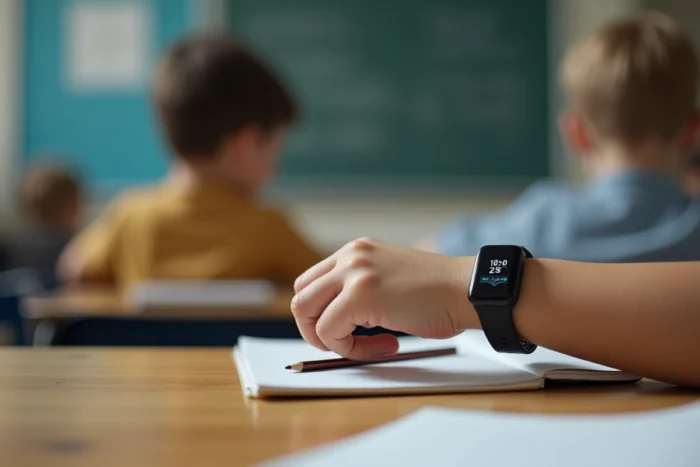
Quick choice grid according to age and use
The right GPS bracelet depends less on the brand than on the usage profile. A six-year-old child walking to school does not have the same needs as a preteen traveling alone by public transport.
| Profile | Priority No. 1 | Type of suitable bracelet |
|---|---|---|
| Child aged 4-7, short trips | Emergency button, simplicity | GPS bracelet or watch with physical SOS, without touchscreen |
| Child aged 8-11, extracurricular activities | Battery autonomy, safety zones | GPS watch with geofencing and adjustable refresh rate |
| Preteen, public transport | Accuracy in urban areas, discretion | Compact GPS tracker with GPS/Wi-Fi/LBS combination |
The cost of the subscription over a year often weighs more than the price of the bracelet. Calculating the overall budget before settling on a model avoids unpleasant surprises. A high-performing device with a poorly sized subscription ends up at the bottom of a drawer by the third month.