Cylinder capacity, type of cutting system, weight, transmission: the technical characteristics of a thermal brush cutter vary significantly from one model to another, so a poor choice can lead to fatigue, mediocre performance, or additional costs. Comparing these parameters based on measurable criteria allows you to target the machine suited to the vegetation and the area to be treated.
Compliance with European Regulation 2023/1230: a recent selection criterion
Online comparisons rarely consider regulatory aspects. The European Regulation 2023/1230, which is gradually replacing the Machinery Directive, imposes stricter requirements on manufacturers regarding risk assessment, traceability, and safety from the design stage. For a purchase in 2025-2026, checking that the thermal brush cutter bears an updated CE marking, accompanied by a complete manual and a EU declaration of conformity, serves as an objective filter even before comparing cylinder capacities.
This regulatory evolution is part of a broader trend. The European Union has plans for stricter standards in the medium term for thermal-powered machines, which may affect the relevance of a model purchased today. A device compliant with Regulation 2023/1230 offers a better guarantee of compatibility with future requirements for reparability and product information.
Detailed sheets allow for comparisons of models based on these technical and regulatory criteria, such as those available on top-debroussailleuse-thermique.com, which lists specifications by usage category.
Cylinder capacity and cutting system: comparative table by type of vegetation
The choice of a thermal brush cutter primarily depends on two intersecting parameters: the engine’s cylinder capacity and the cutting system. Their combination determines the machine’s actual capability in relation to a given terrain.
| Type of vegetation | Recommended cylinder capacity | Suitable cutting system | Typical use |
|---|---|---|---|
| Tall grasses, soft grasses | Low (less than 30 cm³) | Nylon line head | Lawn finishing, edges |
| Bramble, medium underbrush | Medium (30 to 40 cm³) | 3 or 4 tooth blade | Semi-abandoned terrain, slopes |
| Shrubs, tree shoots, woody vegetation | High (over 40 cm³) | Toothed disc or tungsten disc | Intensive clearing, undergrowth |
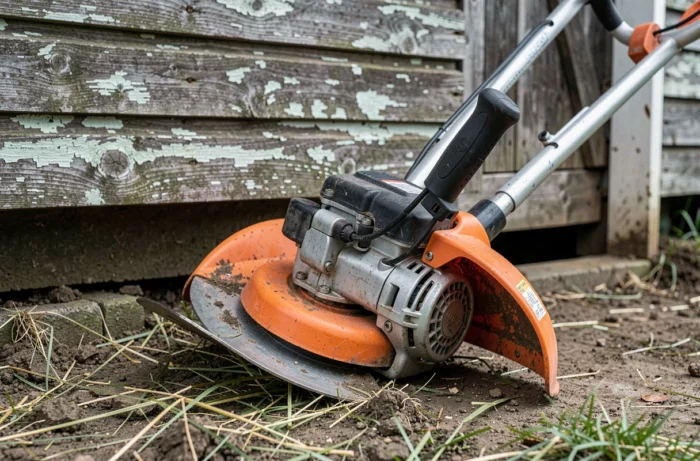
The line head is suitable for soft grasses but wears out quickly on brambles. In contrast, a blade or disc cuts through woody vegetation without straining the engine, provided the cylinder capacity is adequate. Pairing a nylon line with a powerful engine leads to underutilization of the machine, while a disc mounted on an underpowered engine causes blade slowdown and premature wear.
2-stroke or 4-stroke engine
Most thermal brush cutters operate with a 2-stroke engine, which is lighter and more powerful at equal cylinder capacity. The less common 4-stroke engine consumes less fuel and produces less vibration. Conversely, it significantly increases the machine’s weight.
For regular use on uneven terrain, the power-to-weight ratio of the 2-stroke remains more favorable. The 4-stroke is justified for long sessions where consumption and noise become real constraints.
Weight, transmission, and handle: the differences that affect comfort
Power does not compensate for a lack of ergonomics. Two brush cutters with the same cylinder capacity can offer very different experiences based on their weight, type of transmission, and handle shape.
Rigid or flexible transmission
The rigid transmission (metal shaft) transmits torque to the cutting system more effectively. It supports discs and blades without loss of performance. The flexible transmission (flexible cable), lighter and more maneuverable, is suitable for line heads on soft grasses but vibrates more under load.
- Rigid transmission: suitable for blades and discs, better mechanical durability, higher weight
- Flexible transmission: reserved for nylon line, more maneuverable in tight spaces, unsuitable for heavy work
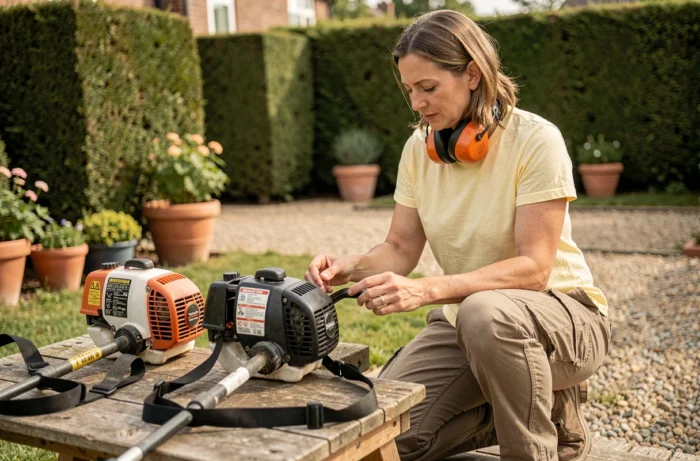
- Detachable pole: facilitates transport and storage, check if the connections remain stable after multiple assemblies
Handle and harness
The bicycle-type handle distributes effort across both arms and is suitable for open areas. The loop or D-shaped handle offers more freedom of movement in cluttered terrain but concentrates effort on one arm.
The harness enhances comfort during sessions longer than half an hour. A simple shoulder harness is sufficient for occasional use. For regular clearing, a double harness with lumbar support reduces back fatigue and stabilizes the machine during cutting.
Thermal brush cutter vs. battery models: what trajectory in 2025
European electrification policies are pushing manufacturers to develop increasingly efficient battery-powered ranges. For a buyer of a thermal brush cutter, the question is not whether the battery will replace thermal power, but when and for what uses.
At this stage, thermal power retains the advantage for heavy work and large areas due to unlimited autonomy (rechargeable tank) and sustained power. Battery models are progressing for light to medium uses, with the benefits of silence and the absence of oil-gas mixing.
- Autonomy: thermal has no time limit, the battery requires recharge breaks or the purchase of additional batteries
- Maintenance: thermal requires oil changes, filters, spark plugs, carburetors – the battery is limited to the cutting system
- Regulation: upcoming European standards could restrict certain uses of thermal in residential areas
For large areas with brambles and dense vegetation, thermal remains the rational choice today. For a modest-sized garden with tall grass, the battery deserves serious comparison.
The most reliable criterion for guiding the purchase remains the intersection of the area to be treated, the dominant type of vegetation, and the frequency of use. An oversized thermal brush cutter costs more to purchase and maintain without providing real benefits on terrain that does not require it. Starting from the vegetation rather than the technical sheet avoids the most common calibration errors.