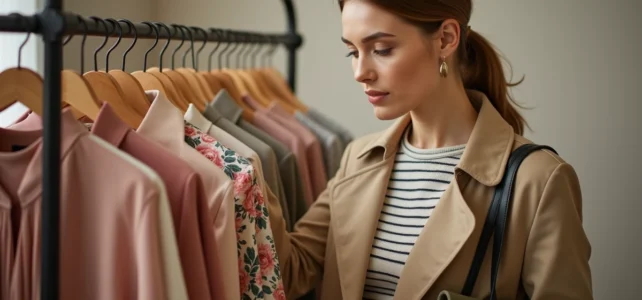
We’ve all experienced the situation: a Saturday afternoon, three hours in a store, two full bags, and when it comes time to put away the purchases, that bitter realization. Half of it goes with nothing. The other half looks like what we already own. Trendy shopping for women is not about the volume of purchases, but about a concrete method that avoids recurring mistakes.
Wardrobe sorting before shopping: the foundation of effective fashion shopping
Before stepping into a store or scrolling through a product page, we start by emptying a shelf. Not the entire wardrobe, just the targeted category: tops, pants, or mid-season jackets. The goal is simple: identify the missing pieces rather than accumulate duplicates.
Specifically, we lay out everything we own in that category on the bed. We eliminate anything that hasn’t been worn in two seasons. What remains forms the real basis of our style, not the one we fantasize about.
From there, we note the gaps: a wide-leg pant that would go with three existing tops, a pair of flats to replace the ones that are worn out. This short list becomes the filter for every purchase. If a piece of clothing does not fill an identified gap, we put it back. When we want to discover the world of Globe Modeuse, it’s also this logic of arbitration that makes navigation productive rather than compulsive.

Cost per wear: the calculation that changes women’s fashion purchases
The price displayed on the tag says almost nothing. What matters is the cost per wear: the price divided by the number of times we will actually wear the piece.
A concrete example. A structured blazer at 120 euros worn twice a week for two years costs less than 60 cents per use. A top at 15 euros worn three times before being relegated to the back of the drawer costs 5 euros per wear. The latter is the wrong calculation, even if the amount spent seems trivial.
This reasoning encourages investing in the pieces we wear most often:
- Everyday shoes, worn five days a week, deserve a higher budget than a pair of evening shoes used three times a year
- A well-cut jean that fits correctly is worth spending double the price of an average model that loses its shape after two washes
- A reasonably good quality leather or durable material bag lasts through the seasons, whereas a trendy low-cost bag deteriorates in a few months
The trick is not to spend more, but to focus the budget on high-rotation pieces and limit impulsive purchases on the rest.
Sales and fashion promotions: smart buying without falling into the trap
Summer and winter sales remain a real lever for savings, provided we don’t buy a piece of clothing simply because it’s on sale. We return to the list established during the wardrobe sorting: if the item is not on it, the discount has no value.
The French law in preparation on fast fashion notably includes the prohibition of advertising for ultra-fast fashion brands and progressive financial penalties through the REP system. In practical terms, aggressive promotions from certain retailers may become rarer in the coming months. It’s better to anticipate now by diversifying purchasing sources.
Alternatives to classic promotions for trendy shopping
Online private sales often offer better deals than in-store sales, because the stock is broader and we avoid the rush that leads to hasty purchases. We can also explore consignment shops and second-hand, where branded pieces circulate at a fraction of their original price.
Returns vary on this point depending on the cities and platforms, but one rule works almost everywhere: try the garment with at least two outfits already owned before finalizing the purchase. If we can’t immediately visualize two combinations, we pass.
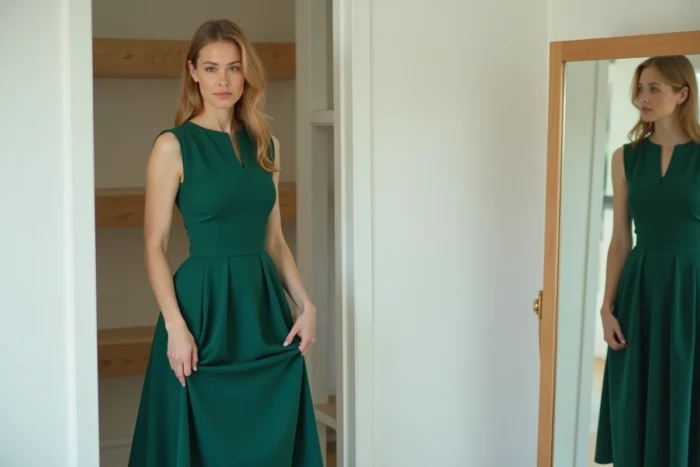
Fashion accessories: the underestimated lever of women’s style
Refreshing a look doesn’t necessarily require a new garment. A scarf tied differently, a belt that cinches the waist on a straight dress, or larger earrings are enough to transform an outfit worn twenty times.
Accessories have a decisive advantage: they depend neither on size nor on body shape, and their cost per wear is often among the lowest in the wardrobe. A well-chosen pair of sunglasses or a structured hat can accompany dozens of different outfits.
- A good quality leather belt can be worn over jeans, a dress, or an open coat, transforming the silhouette each time
- A statement piece of jewelry (wide ring, cuff bracelet) is enough to add dimension to a basic t-shirt and neutral pants
- An intermediate-sized bag, neither too small nor bulky, works for both day and night and avoids the need to multiply purchases
The idea is not to accumulate accessories, but to have a few versatile ones to multiply combinations without multiplying expenses.
Sustainable purchases and women’s shopping: arbitrating without guilt
The female segment represents over 41% of the global clothing market according to Fortune Business Insights. Brands are massively targeting this audience, which means a plethora of offers and constant pressure to consume.
Smart buying, in this context, also means accepting not to follow everything. Wearing a trend is only worthwhile if it integrates with what we already own. A seasonal color works better as an accessory than as a centerpiece, because we will replace it without remorse when it goes out of style.
Casual clothing (well-cut joggers, polished sneakers, soft knits) continues to gain ground in shopping habits. It’s a smart choice by nature: these pieces can be worn in more contexts than formal wear, and their cost per wear drops quickly.
An effective women’s wardrobe is not measured by the number of occupied hangers. It is measured by the number of complete outfits we can assemble with our eyes closed on a rushed Monday morning. Every purchase that brings us closer to this goal is a good purchase. The rest is just noise.