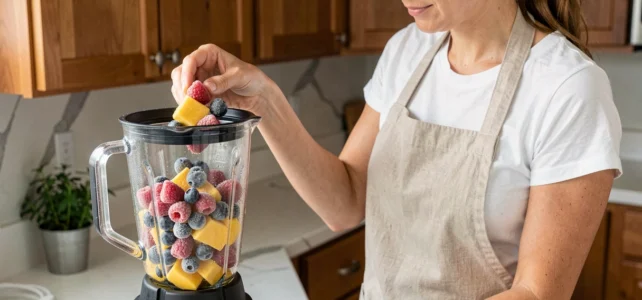
Frozen fruits come out of the freezer at a temperature close to -18 °C. At this stage, their texture resembles that of small blocks of ice, which requires the blender to exert significantly more mechanical effort than for fresh fruits. Effectively blending frozen fruits relies on three key factors: the order in which the ingredients enter the bowl, the management of motor power, and the amount of liquid used.
Bowl Filling Order: The Vortex Logic
Most recent guides converge on a simple principle: liquids go in first, frozen fruits last. This sequence is not arbitrary. The liquid at the bottom of the bowl allows the blades to spin freely from the start and creates a vortex that gradually pulls the solid pieces down.
If the frozen fruits are placed directly on the blades, they get stuck against hard blocks without any lubricant. The motor struggles, the blades slip, and the result is a heterogeneous mixture with intact pieces at the bottom of the bowl.
The assembly logic can be summarized as follows:
- Base liquid (water, milk, plant-based drink) at the bottom, in sufficient quantity to cover the blades by at least two centimeters
- Soft ingredients next (fresh banana, yogurt, peanut butter) that serve as an intermediate layer
- Frozen fruits last, on top, so they gradually descend into the vortex
An article details how to use frozen fruits in a blender by applying this logic to different models, including personal blenders with low capacity.
Pulse Function and Motor Management for Frozen Fruits
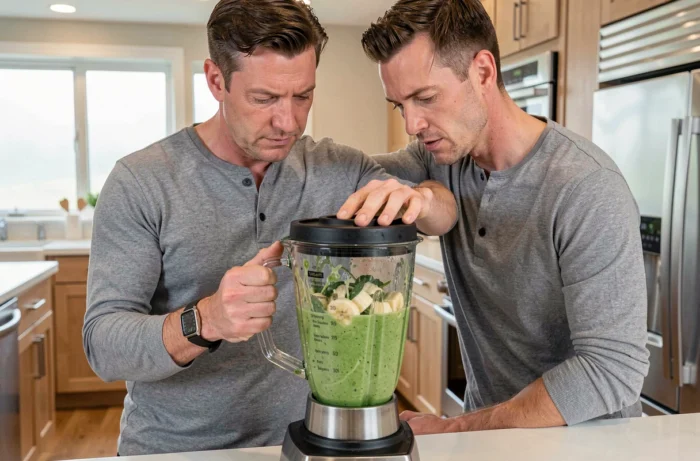
The pulse mode is the most recommended tool for tackling frozen fruits without straining the blender. The principle: short pulses of two to three seconds, repeated several times, before switching to continuous blending.
These pulses serve to break the larger pieces into smaller fragments. Once this step is completed, the fruits circulate better in the bowl and the blades work more evenly. Starting the blender at full power directly on frozen blocks causes rapid overheating of the motor and premature wear of the blades.
The Overheating Trap
A blender running empty or straining against too hard pieces heats up. This heat transfers to the food, accelerating the melting of the fruits and producing a warm smoothie instead of a chilled, creamy preparation. Three to five pulse bursts are sufficient before switching to continuous speed.
If the blender jams despite the pulses, the solution is not to increase the power. It’s better to turn off the device, stir the contents with a spatula to reposition the fruits, then restart. Forcing a jammed motor shortens the device’s lifespan without improving the result.
Liquid Dosage: The Factor That Changes Texture
Too much liquid results in a watery smoothie. Not enough, and the blender struggles to create the necessary vortex. The addition of liquid should be done in small amounts, not all at once.
The most reliable method is to start with just enough liquid to cover the blades, then add more in small doses during blending if the mixture remains too thick. This gradual approach prevents exceeding the tipping point where the texture shifts from creamy to runny.
Which Liquid to Choose Based on Desired Consistency
The type of liquid directly influences creaminess. Water yields the lightest result, whole milk or coconut drink adds fat that thickens the mixture. A liquid yogurt replaces part of the liquid while adding body.
For low-power blenders, adding a bit more liquid compensates for the lack of blade strength, but always in small successive amounts. Pouring all the liquid at once drowns the fruits and dilutes the flavors even before blending has begun.
Resting Time for Frozen Fruits Before Blending
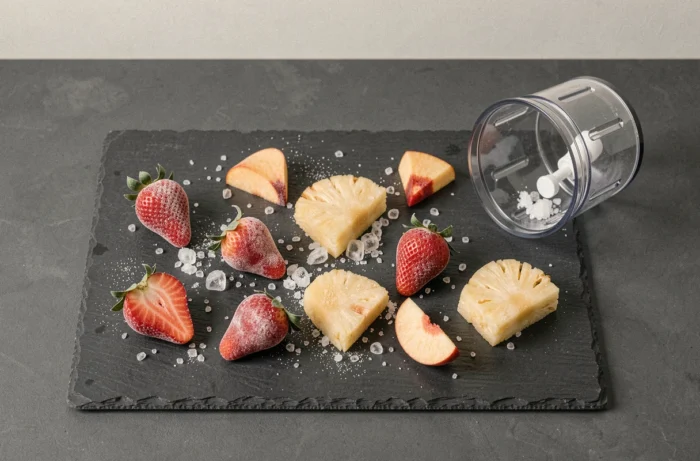
Taking the fruits out of the freezer and placing them directly in the bowl seems logical, but a short resting period at room temperature improves the result. A few minutes are enough for the surface of the fruits to soften slightly without compromising the freezing at the core.
This slight thawing of the surface has two concrete effects. The fruits stick less to each other, reducing the risk of a compact block at the bottom of the bowl. And the blades penetrate more easily into the flesh, which decreases the load on the motor.
A resting period of a few minutes reduces the risk of jamming without compromising the frozen texture. Beyond that, the fruits start to release juice, which alters the liquid/solid ratio and can result in a mixture that is too runny.
Bowl Capacity and Amount of Fruits
Filling the bowl beyond two-thirds of its capacity with frozen fruits prevents the circulation of food. The pieces on top remain intact while those at the bottom are already pureed. It’s better to blend in two batches for a homogeneous result than to overload the bowl and end up with a grainy mixture.
This rule particularly applies to personal blenders whose bowls rarely exceed half a liter. With these models, limiting the load to half the bowl consistently yields a better result than cramming everything in to save time.
Blending frozen fruits ultimately relies on simple yet precise actions: liquid first, pulse at the start, gradual additions, bowl never overloaded. Each step protects the motor as much as it improves the texture of the preparation.