Nuxe and Caudalie occupy the same shelves in pharmacies, share similar price ranges, and both claim a strong natural focus. However, their formulations are based on very different plant logics, and these choices of active ingredients significantly change what your skin receives morning and night.
Plant Actives: Vine vs. Botanical Oils
Caudalie has built its entire identity around the vine and its by-products. Resveratrol, grape polyphenols, and viniferine form the foundation of its flagship ranges like Resveratrol-Lift or Vinoperfect. These molecules primarily act as antioxidants: they protect cells against oxidative stress and help to even out the complexion.
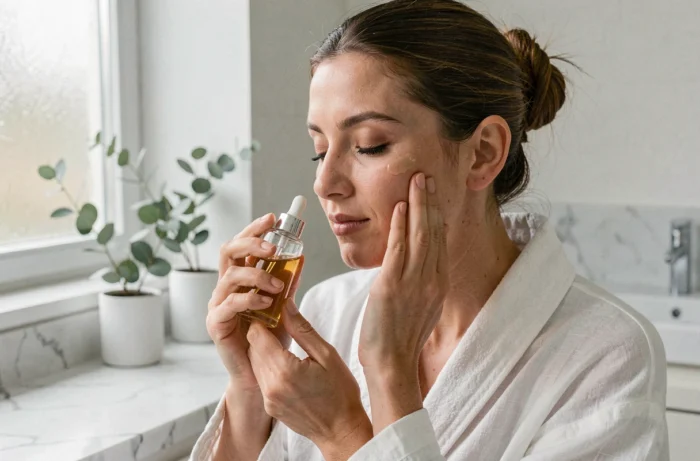
Nuxe takes a different path. The Parisian brand favors blends of precious plant oils (argan, macadamia, borage, camellia) combined with vitamin E. Its iconic product, Huile Prodigieuse, combines several of these oils in a dry, multi-use formula for the face, body, and hair.
By exploring the differences between Nuxe and Caudalie in terms of composition, we understand that the choice between these two brands primarily depends on the skin’s priority need: radiance and antioxidant protection on one side, nutrition and lipid repair on the other.

Texture and Sensory Experience of Nuxe and Caudalie Products
Have you ever noticed that a cream can look promising on paper but be disappointing in use? Texture plays a crucial role in adhering to a routine.
Caudalie products, formulated with grape water, generally offer lightweight, watery textures that absorb quickly. The Resveratrol-Lift cashmere cream is an exception with a more enveloping finish, but the majority of the range remains fluid. This profile suits combination skin or those who are sensitive to greasy films.
Nuxe embraces a richer sensory experience. Huile Prodigieuse, for example, leaves a noticeable satin veil on the skin. The creams in the Nuxuriance Ultra range have a denser consistency, designed for dry or mature skin seeking immediate comfort. The fragrance is also a strong marker for Nuxe, with very recognizable floral and powdery notes.
Impact of Regulation on Fragrances
Regulation (EU) 2023/1545 has expanded the list of fragrance allergens to be declared on cosmetic labels. The number of substances involved has increased from 24 to over 80, including many natural extracts. For highly scented products like Huile Prodigieuse, this means longer labeling and potentially upcoming reformulations to limit allergens above regulatory thresholds.
Caudalie, whose products are often less scented, is presumably less exposed to this constraint. However, no brand using plant extracts can escape it entirely.
Anti-Aging Treatments: Resveratrol vs. Retinol, a Regulatory Arbitration
The anti-aging treatment is the area where the two brands most clearly differentiate themselves technically.
Caudalie relies on resveratrol derived from vine shoots, a polyphenol with antioxidant and firming properties. The Resveratrol-Lift range (serum, day cream, night cream) is entirely centered around this active ingredient. The lifting serum also contains hyaluronic acid for hydration.
Nuxe positions its Nuxuriance Ultra range on a global anti-aging approach: wrinkles, firmness, and hydration. The formula is based on plant cells (saffron, bougainvillea) rather than retinol, which avoids the irritations that this vitamin A derivative can cause on sensitive skin.
New Limits on Retinol in Europe
Since regulation (EU) 2024/996, concentrations of retinol and vitamin A derivatives are strictly limited to 0.3% retinol equivalent for leave-on facial products and 0.05% for body products. New products exceeding these thresholds can no longer be marketed from November 1, 2025, and existing stocks must be sold before May 1, 2027.
Neither Caudalie nor Nuxe made retinol their flagship active ingredient, but this regulation reinforces the relevance of their respective choices. Resveratrol (Caudalie) and plant cells (Nuxe) become even more attractive alternatives in a market where vitamin A options are dwindling.

Range and Versatility: Face, Body, and Hair
Why does this criterion matter? Because many consumers seek to simplify their routine with multi-use products rather than multiplying bottles.
In this area, Nuxe has a clear advantage. Huile Prodigieuse can be applied to the face, body, and hair in one step. The brand also offers variations (floral, gold, neroli) that allow for fragrance changes without altering the routine. Nuxe covers more areas of the body with fewer products.
Caudalie structures its ranges by skin concern:
- Vinoperfect for radiance and pigmentation spots, with a serum that has become a reference in pharmacies
- Resveratrol-Lift for firmness and established wrinkles
- Vinopure for combination to oily skin prone to imperfections
- Vinosource-Hydra for hydrating sensitive or dehydrated skin
This segmentation requires choosing a specific range according to skin type, but it allows for more precise targeting of needs.
Selection Criteria Based on Your Skin Type
Rather than presenting a generic table, here are concrete situations where each brand has the advantage:
- Dry, tight skin: Nuxe, thanks to its nourishing plant oils and rich textures (Nuxuriance Ultra, Huile Prodigieuse)
- Combination skin with spots or dull complexion: Caudalie Vinoperfect, whose radiance serum specifically targets evenness of tone
- Sensitive and reactive skin: Caudalie Vinosource-Hydra, formulated without heavy fragrance and based on soothing grape water
- Looking for a multi-use product for face, body, and hair: Nuxe, the only one to offer this versatility in a single bottle
- Priority on anti-aging firmness without retinol: both brands are suitable, with a slight advantage for Caudalie for scientifically documented resveratrol
Budget is not a major discriminating factor: both brands are positioned in a comparable price range in pharmacies. The choice is made based on texture, main active ingredient, and area of application, not on price.