
You have just received a beautiful bouquet of lilies. A few days later, an orange powder covers the tablecloth, the sleeves of your shirt, and even the edge of the vase. The culprit is not the pistil, contrary to what many believe, but the stamens, those fine stems topped with small pollen sacs.
Removing the pistil from lilies is a common expression, but it actually refers to the removal of the stamens. Understanding this nuance changes the way we care for these flowers.
Stamens or pistil of the lily: the confusion that changes everything
The lily has six stamens arranged in a circle around a single central pistil. The stamens are the male organs: each one has an anther at its tip filled with pollen. The pistil, on the other hand, is the female organ, often thicker, which receives the pollen for fertilization.
Have you ever noticed that powder that stains your fingers at the slightest contact? It comes exclusively from the anthers, not from the pistil. Therefore, removing the pistil does not protect your tablecloth or your clothes. It is the stamens that need to be cut to avoid stains.
The confusion comes from everyday language. Many websites and florists talk about “removing the pistil” while showing the action on the stamens. Knowing why to remove the pistil from lilies helps to understand that the real action targets the stamens and their pollen.
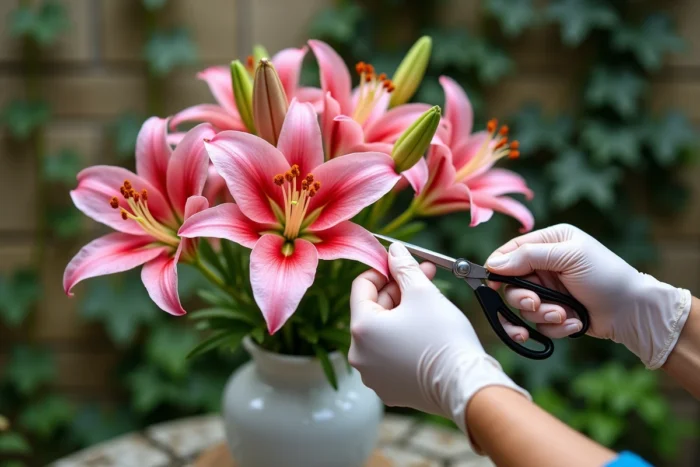
Removing the stamens from lilies: the right action at the right time
The ideal time to intervene is just after the flower bud opens, when the anthers are still closed and slightly sticky. At this stage, the pollen is not yet dry and does not disperse into the air.
Technique with bare hands
Pinch the base of each stamen between your thumb and index finger, then gently pull outward. The stamen detaches effortlessly. Work over a sink or a sheet of newspaper to catch any residues.
Technique with tweezers or scissors
If the anthers have already started to release pollen, use a small pair of tweezers. Avoid touching the anthers with your fingers, as lily pollen stains skin and fabrics stubbornly. Cut the stamen stem as close to its base as possible.
Here are some tips to successfully perform this action:
- Intervene as soon as the flower opens, before the pollen dries and becomes powdery
- Wear thin gloves or use a paper tissue if the pollen is already visible, as orange stains are difficult to remove in the wash
- Remove the six stamens from each flower, without touching the central pistil which does not produce any pollen
Lilies in wedding bouquets: a case where removal is non-negotiable
Lilies are among the most commonly used flowers in high-end wedding arrangements. Their ample silhouette and strong fragrance make them a frequent choice for single-flower bouquets, a trend that is confirmed in 2025 and 2026 according to industry professionals.
The problem is clear: a white wedding dress in contact with lily pollen risks an irreversible stain. Florists specializing in weddings systematically remove the stamens during the arrangement. A bouquet of lilies for a wedding cannot be conceived without this prior removal.
The same precaution applies to table centerpieces adorned with lilies, arrangements placed near light-colored tablecloths, and lilies placed in a room with delicate linens. Pollen does not simply fall by gravity: a draft is enough to disperse it over several dozen centimeters.
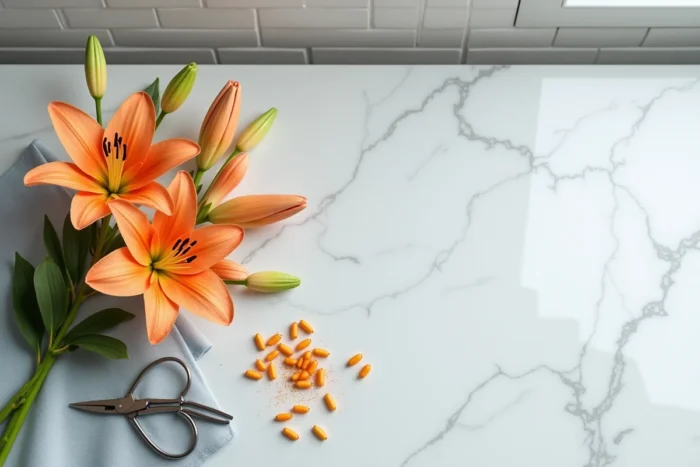
Longevity of the lily bouquet: what matters beyond the stamens
Removing the stamens helps prolong the freshness of cut lilies. Without stamens, the flower no longer expends energy on pollen maturation. The flower stays open and fresh significantly longer.
A often-overlooked factor plays a crucial role in the longevity of the bouquet: ethylene, a gas emitted by ripe fruits. Lilies are particularly sensitive to it. Placing a bouquet of lilies next to a bowl of apples or bananas visibly accelerates wilting within hours.
Other actions complement the removal of the stamens:
- Change the water in the vase every two days while recutting the stems at an angle to maintain good absorption
- Keep the bouquet away from any direct heat source (radiator, window in full sun) and any ripe fruit
- Remove wilted flowers as they appear, as they release ethylene which accelerates the degradation of nearby flowers
- Use lukewarm water rather than cold when filling, as lily stems absorb water better at room temperature
Lily pollen stain on fabric: how to recover from the accident
Despite all precautions, pollen can sometimes land on clothing or a tablecloth. The usual reflex, rubbing with a damp cloth, is the worst thing to do. Water sets the pigment in the fibers of the fabric.
The most effective method is adhesive tape. Apply a piece of tape to the stain, press lightly, then peel off. The pollen transfers to the sticky surface without penetrating deeper into the fabric. Repeat the operation until the stain is completely gone.
If the stain has already been wet, expose the fabric to direct sunlight for a few hours. The pigments in lily pollen are sensitive to ultraviolet light and naturally fade. This trick works on cotton and linen, but less so on synthetic fibers.
Removing the stamens remains the simplest action to enjoy lilies without unpleasant surprises. Two minutes per flower is enough to protect your home, your clothes, and the longevity of the bouquet. The next time you hear about removing the pistil, you will know that the real culprit goes by another name.