
Alicia is among the female names that marked the 1990s and 2000s in France. Derived from the Germanic Adalheidis, this name, borne by several hundred newborns each year, is currently experiencing a significant decline. Understanding the meaning of the name Alicia, its etymological roots, and its demographic trajectory helps to situate this name within the French civil registry.
Alicia vs. Alice: Two Divergent Demographic Trajectories
Alicia and Alice share the same Germanic root, but their popularity curves tell two distinct stories. Alice remains firmly established among the most given names in France, while Alicia shows a 43% decline over five years.
| Name | Estimated Births in 2025 | 5-Year Trend | Average Age of Bearers (2026) |
|---|---|---|---|
| Alicia | 405 | Marked decline | 23 years |
| Alice | Significantly higher than Alicia | More stable | More dispersed (bearers of all ages) |
This table highlights a recurring phenomenon in the demographics of names: a variant can experience an intense peak and then fade away, while the classic form maintains a broader base. Alice benefits from a historical anchoring spanning several centuries. Alicia, more recent in French usage, behaves like a trendy name with a shorter life cycle.
The average age of 23 for Alicias in 2026 confirms that the vast majority of attributions concentrate within a window of about fifteen years, centered around the early 2000s. This generational tightening is a classic marker of names borne by a single wave of births.
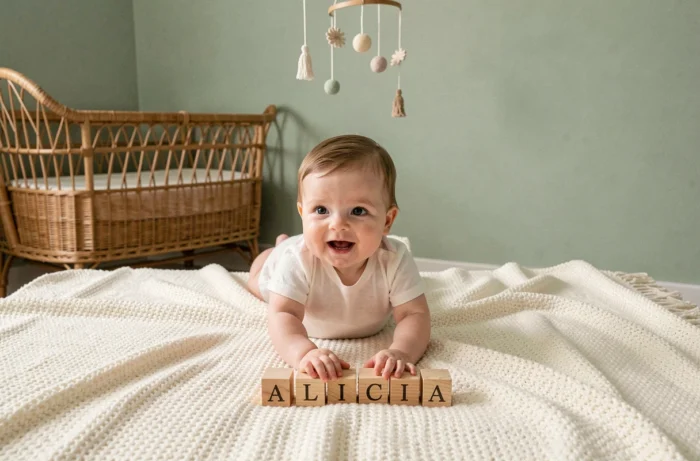
Germanic Etymology and Lineage with Adalheidis
Alicia comes from the Old High German Adalheidis, composed of two elements: adal (noble) and heid (lineage, nature). The name literally means “of noble lineage”. This root has spawned a family of names spread throughout medieval Europe.
The linguistic lineage passes through several stages. Adalheidis simplifies to Adelheid in Germanic languages, then contracts to Aalis in Old French, a form that gives rise to Alice. Alicia appears as a Latinized variant of Alice, popularized in Spanish-speaking and English-speaking countries before gaining traction in France.
A Family of Names with Multiple Branches
- Alice, the classic French form, attested since the Middle Ages and borne by several queens and princesses across Europe
- Alicia, a Latin variant widespread in Spain, Latin America, and the English-speaking world, introduced later in France
- Alix, a medieval form that has remained discreet but is regularly rediscovered by parents seeking short names
- Adélaïde, a direct cousin more faithful to the Germanic etymon, positioned on a more classic register
All these variants refer to the same notion of nobility. However, their popularity trajectories do not overlap: each has experienced its own cycles of adoption according to the times and countries.
Regional Disparities of the Name Alicia in France
INSEE data shows that Alicia does not have the same weight across territories. These marked regional disparities reflect local dynamics of name choices that go beyond simple national trends.
Names with Latin or Hispanic sounds tend to fare better in southern regions and in areas where the Hispanic or Lusophone population is more present. Conversely, in regions where short and classic names dominate (Alsace, Brittany), Alice maintains a clear lead over Alicia.
Why Do These Disparities Persist?
Several factors explain this uneven geography. The “-ia” sound links Alicia to a register perceived as Mediterranean. Parents who choose this name often do so in connection with a family culture or a specific phonetic aesthetic.
The national decline of Alicia thus masks contrasting local realities. In some departments, the name continues to be given regularly, while in others, it has practically disappeared from birth records.

What the Decline of Alicia Reveals About Name Cycles in France
The case of Alicia illustrates a well-documented mechanism: the “extended” variants of a classic name experience shorter peaks of popularity than the original form. Alice, a bisyllabic name, traverses decades with a regularity that its trisyllabic variant cannot replicate.
The current trend in France favors short names, often with two syllables. This structural preference mechanically penalizes forms like Alicia, Élisa, or Aurélia, which had benefited from a surge in popularity for names ending in “-a” in the 1990s-2000s.
With 405 births recorded in 2025, Alicia now ranks 277th among female names. The name has not disappeared, but it has shifted from a common name status to that of a discreet name within a generation.
The feast day of Alicia is celebrated on December 16, in reference to Saint Alice, an abbess whose memory is shared with all the variants of the name. This connection to the liturgical calendar reminds us that, despite its contemporary image, Alicia is part of an ancient lineage that spans over ten centuries of European history.
The name maintains a notable international presence, borne by personalities such as Alicia Keys or Alicia Vikander, ensuring visibility beyond French borders. Its trajectory in France remains a case study for those interested in the mechanisms of diffusion and decline of names.