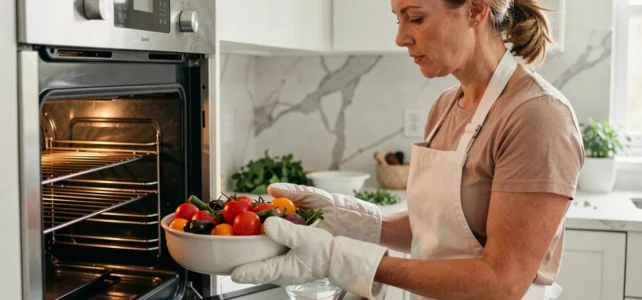
Steam cooking in the oven relies on a parameter that most guides overlook: controlling the humidity level in the chamber. Without mastery of this factor, steam remains a mere cosmetic effect on the crust of the bread or an insufficient mist to cook a fish fillet through. Here we detail the settings, technical pitfalls, and equipment choices that separate effective steam from decorative steam.
Humidity Level and Thermal Regulation: The Real Lever of Steam Cooking in the Oven
A conventional oven without injection operates in a dry atmosphere, with humidity levels dropping below 10% as soon as the temperature exceeds 180 °C. Introducing steam without control (a tray of boiling water, manual spray) creates a brief spike in humidity, followed by rapid evaporation that further dries the chamber due to rebound effect.
Ovens equipped with a regulated steam injection generator maintain humidity levels between 40% and 100% depending on the chosen program. It is this stability that allows for even cooking, not just the mere presence of water.
In practice, we recommend distinguishing three levels of use. For vegetables and fish, a pure steam mode (100% humidity, between 85 °C and 100 °C) preserves textures without overcooking. For meats and poultry, a combined mode (steam + convection heat, around 160-180 °C) sears the outside while keeping the inside tender.
For baking, a burst of intense steam in the first few minutes followed by a shift to dry heat forms the crust. Mastering oven steam cooking with 10 Grammes requires accurately identifying which of these three registers each preparation falls into.
Steam Cooking Without a Dedicated Steam Oven: The Reverse Bain-Marie Method
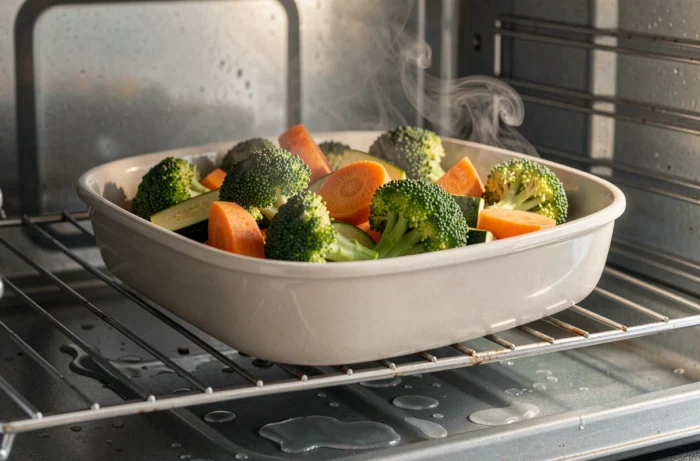
Not all households have an oven with an integrated reservoir. The reverse bain-marie technique remains the most reliable for generating steam in a traditional oven, provided a precise protocol is followed.
- Place a deep baking tray on the oven floor and fill it with boiling water (not cold, as this would cause the chamber temperature to drop by several degrees at once).
- Position the food on the upper rack, in a perforated container or directly on a slotted tray so that the steam circulates around the piece.
- Close the door quickly and do not open it during the first ten minutes, as each opening releases almost all of the accumulated steam.
- Top up the water if the cooking exceeds thirty minutes, pouring hot water in from the side to limit heat loss.
The initial water temperature determines the success of the process. Cold water in an oven preheated to 200 °C causes thermal shock on the floor, slows steam generation, and creates uneven cooking during the first few minutes.
Limitations of This Artisan Method
The humidity level achieved remains unpredictable and decreases over the course of cooking. For country bread or root vegetables, the result will be acceptable. For delicate fish or a flan, the lack of regulation results in significant texture discrepancies from one batch to another.
Mid-Range Combined Steam Ovens: What Changes in Practice
The recent diffusion of combined steam ovens in an accessible price range has changed the game. These devices integrate a removable water reservoir and a simplified injection system that produces steam in a few minutes, without connection to the mains water supply.
Two points deserve particular attention before purchase. The first concerns the capacity of the reservoir. A one-liter reservoir covers about forty-five minutes of continuous steam in pure mode. For long cooking (roasting, braising), an intermediate refill is necessary, which involves opening the oven and temporarily losing the accumulated steam.
The second concerns the position of the generator relative to the chamber. Models with an external generator (rear or side unit) produce drier and more homogeneous steam than those whose reservoir heats directly in the cavity. This difference is particularly noticeable in pastries and breads, where the quality of the steam directly influences crust formation.
Maintenance of the Steam Circuit
Limescale is the silent enemy of any steam oven. Regular descaling of the reservoir and injection nozzles prevents the gradual loss of flow. We observe that the majority of reported failures in combined ovens concern clogging of the steam circuit, not electronic failure.
Temperature and Cooking Time for Steam Cooking According to Foods
Pure steam cooks at low temperatures, which radically changes the usual benchmarks. A cod fillet that takes twelve minutes at 200 °C in dry heat requires about fifteen to eighteen minutes at 90 °C in pure steam, but with an incomparable result in terms of tenderness.
- Green vegetables (broccoli, beans, zucchini): pure steam between 95 °C and 100 °C. Short cooking to preserve crunchiness and color.
- White fish and shellfish: pure steam at 85-90 °C. Lowering the temperature protects delicate flesh from flaking.
- Whole poultry or roast: combined mode steam + convection heat around 170 °C, with a final phase in dry heat to brown the skin.
- Bread and pastries: burst of steam at full power for the first five to eight minutes at 230 °C, then switch to convection only.
Convection heat combined with steam reduces energy consumption compared to natural convection alone. Limiting unnecessary preheating (this phase consumes a significant portion of the total energy of a cooking process) also contributes to the overall efficiency of the process.
Safety and Steam Projections: An Often Overlooked Point
Opening an oven in steam mode releases a high-temperature steam flow directly at face level. Recent models incorporate safety devices on water reservoirs and doors designed to limit surface temperature, in anticipation of stricter European standards for household machines.
In the meantime, the reflex to adopt is simple: open the door a few centimeters, wait three to five seconds for the steam cloud to dissipate, then open fully. This gesture significantly reduces the risk of burns, especially for long cooking where the amount of steam accumulated in the chamber is maximal.
The choice between artisan method and combined oven depends on the frequency of use. For weekly steam cooking, a hot water tray is sufficient with a bit of rigor. For daily or semi-professional use, investing in a regulated injection device is justified by the consistency of results and the increased safety of the device.