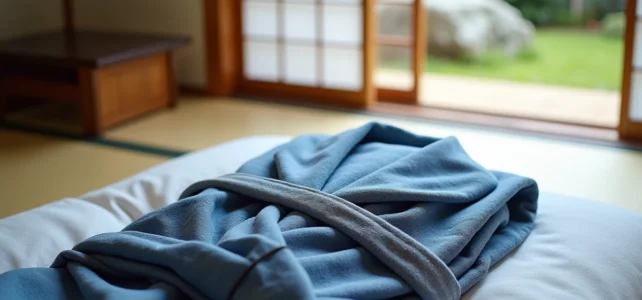
In most Japanese accommodations, a nightwear is placed on the bed or folded in the closet before the guest’s arrival. This pajama, sometimes referred to as room wear, is part of the room’s amenities just like towels or slippers. Many travelers wonder what they can do with it: wear it outside the room, keep it after their stay, or ignore it in favor of their own nightwear.
Room wear and yukata: two garments, two usage logics
The term room wear refers to a Western-style pajama set (pants and long-sleeved top, often made of cotton or lightweight polyester) found in business hotels, chain hotels, and most capsule hotels. Its function is strictly practical: to sleep comfortably without using one’s own clothes.
The yukata follows a different logic. This lightweight cotton kimono, tied with an obi (fabric belt), is associated with ryokan and establishments that have hot springs. The yukata is not just a simple pajama. It is worn in a specific way (left side over the right side, the reverse being reserved for the deceased) and accompanies the stay well beyond the room.
Understanding the difference between these two garments avoids several misunderstandings. A business hotel room wear is not worn at breakfast in the dining area. A ryokan yukata, however, is. The rules vary by establishment, but the type of clothing provided indicates the permitted uses.
The cultural context of the yukata and room wear sheds light on habits that often surprise Western travelers. To delve deeper into the topic, check out this article on pajamas in hotels in Japan.
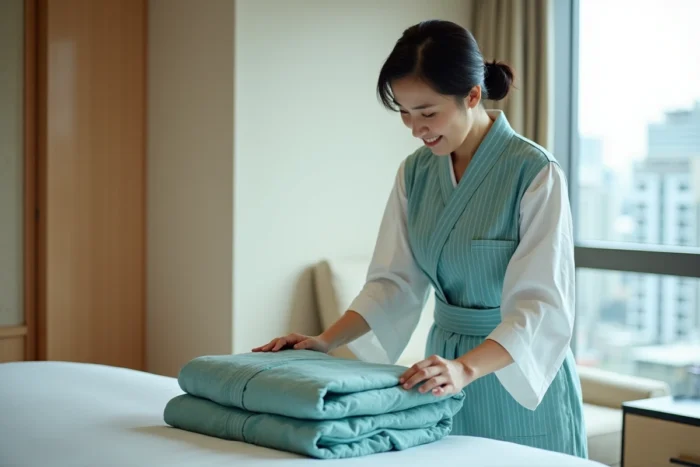
Japanese hotel pajama: where can you wear it and where should you avoid it
The tolerance regarding wearing pajamas in common areas is one of the points that most confuses foreign visitors. The rules are not uniform, but a general principle emerges.
Ryokan and onsen: the yukata circulates freely
In a traditional ryokan, the yukata serves as the default outfit for the duration of the stay. Guests wear it in the hallways, at the establishment’s restaurant, in the gardens, and even to the baths. Some ryokan in hot spring areas even allow walking in yukata in the streets of the neighborhood, a common practice in cities like Kinosaki Onsen.
The only constraint concerns how to tie the garment. The obi is always crossed left side over right side. Staff may offer a demonstration upon arrival, which simplifies things for those who have never worn a kimono.
Business hotels and capsule hotels: use limited to the room
In a standard business hotel, the provided room wear is designed for the room. Going down to the lobby, to the vending machine, or to the dining area in pajamas is considered inappropriate. Some establishments display discreet signage reminding guests of this limit.
Recent capsule hotels, however, adopt a slightly more flexible approach. The provided loungewear can often be worn in internal relaxation spaces (shared bathroom, manga area, lounge). The limit remains outside the building.
Keeping the pajama when leaving: what hotels really expect
The short answer: no, the pajama or yukata provided is not a gift. It is part of the establishment’s linen, just like the sheets. Taking it away technically constitutes theft, even if no hotel will search your luggage.
Some nuances deserve to be noted:
- Disposable items (night socks, bath caps, toothbrushes) are for single use and meant to be taken or thrown away. There is no ambiguity regarding these items.
- The washable fabric room wear from business hotels and capsule hotels is collected, washed, and redistributed. Its cost is included in the nightly rate, but it remains the property of the hotel.
- In some high-end ryokan, a new yukata may be offered for sale in the souvenir shop. This option allows you to leave with a similar garment without taking the one from the room.
Doubt often arises from the fact that Japanese hotels provide an unusually generous amount of amenities for a European traveler: slippers, bathrobes, complete toiletry sets. Everything that is individually packaged is disposable; everything that is not remains on-site.
Should you bring your own pajamas for a stay in Japan
The answer depends on the type of accommodation planned and the personal comfort sought.
In a ryokan, the provided yukata is part of the experience. Bringing your own flannel pajamas is like ordering coffee in a matcha tea room: no one will stop you, but the interest of the place lies elsewhere. Wearing the yukata, even awkwardly tied, contributes to immersion in the Japanese culture of accommodation.
For a trip combining business hotels and capsule hotels, bringing lightweight nightwear may make sense if synthetic materials or standardized sizes pose a problem. The provided room wear follows Japanese sizes, which are often more fitted than European sizes. A larger traveler may find themselves with a top that is too short or pants that are too tight.
Points to consider before deciding:
- Business hotels and capsules almost always provide pajamas, which helps lighten the suitcase.
- Hostels and guesthouses generally provide nothing, unlike hotels.
- The yukata from ryokan is also worn to the baths, which avoids transporting an extra garment between the room and the onsen.
The generalization of provided pajamas in Japanese hospitality, including in budget establishments, remains a distinctive feature of the country’s hospitality. Rather than filling your suitcase, it is simpler to let yourself be guided by what each establishment offers. One reflex to keep: check if the garment is disposable or reusable before slipping it into your bag.