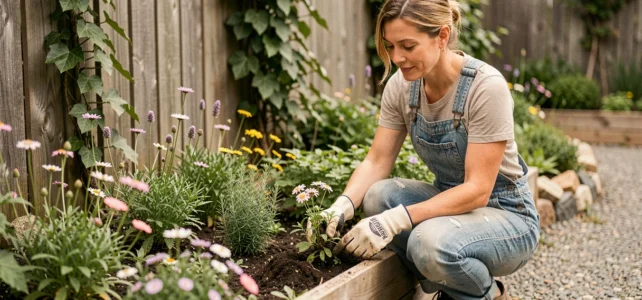
A natural garden is not just about letting the grass grow without intervention. It relies on choices of plants, soil, and water management that mimic the functioning of a local ecosystem. Successfully creating this environment requires understanding a few simple mechanisms before planting anything.
The soil as the starting point for any natural landscaping
Before choosing your plants, take a look at what grows spontaneously in your garden. Dandelions indicate compacted soil. White clover signals a lack of nitrogen. These free clues guide your decisions better than a plan drawn on paper.
Take a handful of moist soil and squeeze it. If it forms a sticky ball, your soil is clayey. If it crumbles immediately, it is sandy. Adapting plantings to the existing soil avoids half of the failures. Clay soil retains water: there’s no need to install an expensive automatic irrigation system. Sandy soil drains quickly: Mediterranean plants thrive there effortlessly.
Mulching plays a central role in a natural garden. Covering the soil with dead leaves, branch chippings, or straw limits evaporation, nourishes earthworms, and prevents most weeds from germinating. You will find additional resources on these techniques at www.spotjardin.com, which details many approaches suited to environmentally friendly gardening.
Flowering meadow: the signature of the natural garden in France
Have you noticed those colorful strips along roadsides or in municipal parks? These are flowering meadows, and they have become the flagship trend of natural gardening in France since 2024.
Unlike a structured perennial bed, the flowering meadow reaches its full maturity in two to three years. It then offers staggered blooming from March to October, without watering or synthetic fertilizers. The principle: sow a mix of local species (poppies, centaureas, daisies, yarrow) on a roughly prepared soil.
Installing a flowering meadow on a small plot
No need for a large space. A strip of a few square meters along a fence or at the edge of a terrace is sufficient.
- Start by stripping the existing lawn for a few centimeters to reduce competition from the grasses already in place
- Rake the surface without turning the soil deeply, then sow the mix by scattering it in the fall or early spring
- Mow only once or twice a year (late summer and possibly late winter) to allow the seeds to reseed naturally
In the first year, the result may seem modest. Pioneer annuals dominate. In the second year, the perennials take over. Patience is the only real investment in a flowering meadow.
Dry garden and water conservation: a landscaping suited to the current climate
Episodes of drought are increasing in France. The dry garden, inspired by Mediterranean landscapes, is among the most requested styles since 2024. Its principle relies on plants capable of surviving with very little water once established.
Lavenders, sages, ornamental grasses, sedums, euphorbias: these plants share a common trait. Their deep roots and adapted foliage limit water loss. A well-designed dry garden requires almost no watering after the first two years of establishment.
Structuring dry areas and wet areas
A natural garden is not uniform. Identify places where water stagnates after rain and those that dry out within hours. These micro-zones dictate the distribution of plants.
In draining areas, install a mineral mulch (gravel, pumice) that reflects heat and is suitable for arid land plants. In wet areas, favor species that tolerate standing water: marsh irises, willowherbs, astilbes. Creating these contrasts reproduces the diversity of a natural environment.

Encouraging biodiversity without turning your garden into a wasteland
Leaving a “wild” corner does not mean abandoning all management. The goal is to create specific micro-habitats that welcome beneficial auxiliaries (pollinators, aphid predators, decomposers).
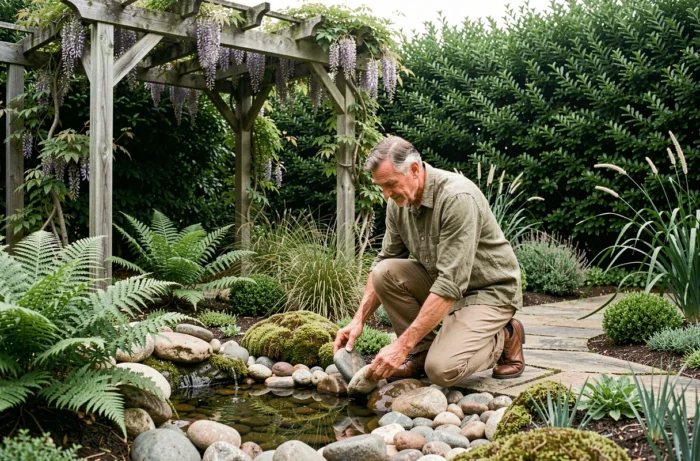
A pile of dead wood in a shaded corner shelters hedgehogs and wood-boring insects. A zone of stacked flat stones offers refuge for lizards. A water point, even a simple buried container with an escape ramp, attracts birds and amphibians.
- Keep the dry stems of perennials until spring: they serve as winter refuge for insects
- Vary the heights of vegetation (ground covers, shrubs, small trees) to multiply ecological niches
- Avoid monospecific hedges of thuja or laurels, and prefer country hedges mixing hazelnuts, privets, dogwoods, and hawthorns
A natural garden productive in biodiversity is managed, not abandoned. Two to three targeted interventions per season are sufficient: a high mowing of the meadow, light pruning of shrubs, and renewing the mulch.
Reduced maintenance of the natural garden: what it concretely changes
The time savings are often the primary motivation. Mowing a traditional lawn requires weekly intervention from March to October. A flowering meadow combined with perennial beds suited to the soil reduces this frequency to a few sessions per year.
The budget follows the same logic. Less watering, no chemical fertilizers, no phytosanitary treatments. Local plants resist diseases better because they have co-evolved with the pathogens of the area. Choosing local plants divides maintenance time by two or three.
The natural garden, however, requires a longer observation phase at the start. Accepting that some areas may look “messy” in the first months is part of the process. The result, after two or three seasons, is a living, autonomous space that is significantly less resource-hungry than a conventional garden.