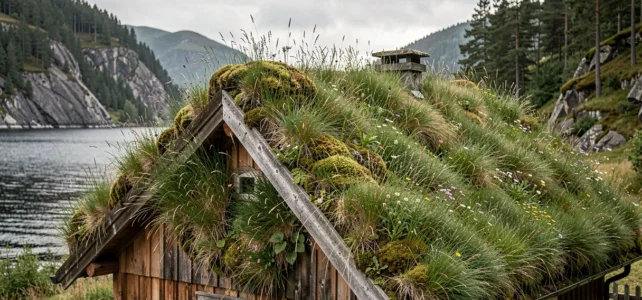
On the heights of Bergen or in the valleys of Trøndelag, one regularly encounters roofs covered with low grass, sometimes even sprinkled with wildflowers. This Norwegian green roof is not a decorative whim. It responds to specific climatic constraints, and its resurgence in new construction is due as much to local heritage as to recent technical advancements.
Modular Sedum Systems: The Game-Changing Quick Installation
What articles on Scandinavian tradition often overlook is the emergence of pre-cultivated sedum trays ready for installation. These cassettes arrive on site with substrate and vegetation already developed. They are clipped onto the supporting structure, and the roof becomes functional in a few hours instead of several days.
The Norwegian company Bergknapp, for example, offers a system for recovering used cassettes (a deposit principle called “pant” in Norwegian). This recovery circuit transforms the green roof into a standardized industrial product, far from the artisanal image it is still associated with.
For individuals, this industrialization significantly reduces technical constraints. It is no longer necessary to calculate the drainage layers oneself or to select the suitable species. We are talking about an approach comparable to the installation of solar panels: a calibrated, tested module, delivered turn-key. The difference with the green roof in Norway of the past, custom-made with peat and birch bark, is considerable.
Green Roof and Thermal Insulation: How It Works in a Nordic Climate
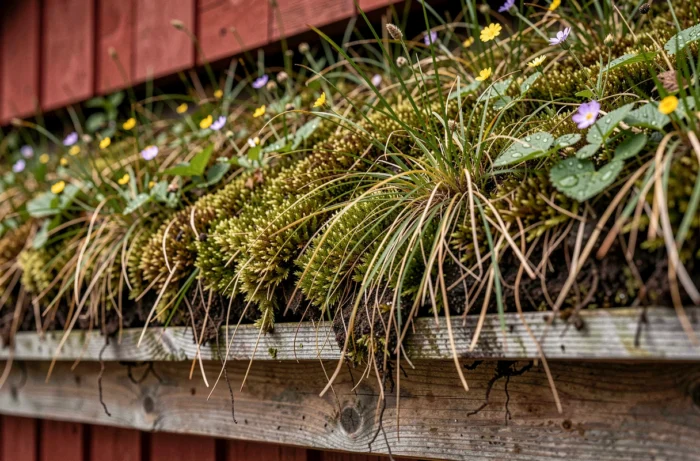
The first reflex is to think of warmth in winter. The layer of substrate and vegetation indeed creates a thermal buffer that limits heat loss. In Norway, where temperature differences between seasons are marked, this additional mass on the roof acts as a regulator.
The lesser-known effect concerns summer. Norwegian media specialized in energy and climate have documented the link between green roofs and passive cooling of buildings during summer overheating. The moist substrate and the evapotranspiration of plants lower the surface temperature of the roof compared to a traditional tile or metal covering.
A Double Effect on Indoor Temperature
In winter, the vegetation layer slows the outgoing heat flow. In summer, it absorbs solar radiation instead of reflecting it into the house. It is this double mechanism that interests Norwegian builders in a context where heat episodes are becoming more frequent, even in the south of the country.
Feedback varies on this point depending on the thickness of the substrate and the exposure of the roof, but the physical principle remains the same: the denser the plant mass, the more pronounced the buffering effect.
Urban Projects in Norway: From Cabins to Government Districts
The Norwegian green roof is no longer limited to mountain cabins and second homes in the fjords. A recent dynamic is propelling it towards large institutional and urban projects. Bergknapp has notably worked on the Regjeringskvartalet project in Oslo, the new government district of the capital.
This shift is significant. We move from a rural tradition to a standard expected in large-scale urban operations. Norwegian architects now integrate greening from the design phase, rather than as a cosmetic addition at the end of the project.
Urban Microclimate and Individual Houses
In the city, construction density creates heat islands. Green roofs help mitigate this phenomenon by absorbing some of the radiation and releasing moisture. For individual houses located in peri-urban areas, the effect is more localized but remains measurable on indoor temperature.
There is also a growing interest in green flat roofs on contemporary wooden constructions. Modern Norwegian architecture favors horizontal lines and natural materials, and the green roof fits naturally into this constructive grammar.
Maintenance of a Green Roof: What to Discover After the First Year
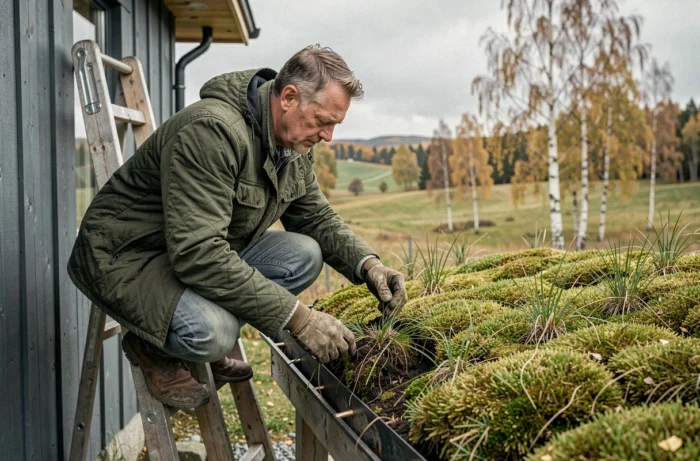
Installing a green roof is one thing. Keeping it in good condition is another. On this subject, the available content often remains vague. Here are the concrete points to monitor:
- The drainage must be checked at least once a year. A drain blocked by roots or debris retains water and weighs down the structure, which can pose a problem on a wooden frame sized to the minimum.
- The chosen plant species determine the frequency of maintenance. Sedum, a frost-resistant succulent, requires very little intervention. Grasses or flowering plants require seasonal weeding to prevent invasion by unwanted species.
- The waterproofing under the substrate remains the critical point. A failing membrane turns the insulation asset into a source of infiltration. A visual inspection of the waterproofing details around the perimeter is recommended after each winter.
- The weight of the water-saturated substrate after heavy rains can far exceed the dry weight. The supporting structure must have been calculated accordingly from the design stage.
Modular systems like those from Bergknapp simplify some of these constraints, as the cassettes incorporate their own drainage layer. Replacing a damaged module can be done without touching the rest of the roof.
Materials and Construction: Why Wood Remains the Preferred Support
The majority of Norwegian houses with green roofs rest on a wooden frame. This choice is not just cultural. Wood offers a favorable strength-to-weight ratio, allowing it to support the load of the substrate without over-sizing the frame.
The combination of wood and greening also produces a carbon footprint significantly lower than that of a concrete construction with a traditional roof. Wood stores carbon, vegetation absorbs it, and together they reduce energy needs for heating as well as cooling.
Norwegian builders today use glued laminated timber or CLT (cross-laminated timber) for flat roof structures, allowing for larger spans and facilitating the integration of thick vegetation layers.
The green roof in Norway is no longer a folkloric remnant of the Viking age. It is a calibrated technical component, mass-produced, installed on modern wooden structures, and deployed both on Lofoten cabins and on government buildings in Oslo. The next step, already underway, is to couple these roofs with solar panels, with both technologies sharing the same space without competing.